
Author Archives: keith

the end of the road for bhs?

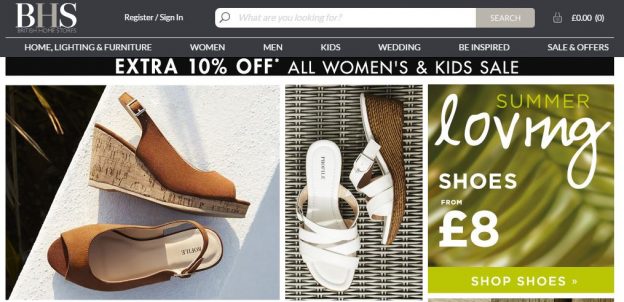
British Home Stores (BHS) the high street retailer has entered into administration with a risk to ~ 11000 jobs. The store founded in 1928 and was a constituent of the FTSE 100 until 2000 when it was purchased by Sir Philip Green and taken private it later became a member of Green’s Arcadia group. In 2015 BHS was sold to the consortium Retail Acquisitions Ltd for the nominal value of £1.

Only last month there were reports of financial difficulties and the company sought a CVA (company voluntary agreement) It was said to have renegotiated its rents with its landlords. It had already in previous months closed stores in several major cities. It is rumoured to have a pension deficit of over £200 million .

This is the highest profile high street administration since the administration and closure of the Woolworth chain in 2008.

So what went wrong? From various reports I have heard today it seems that people fell out of love with BHS, they did not have a USP one person even said that the British in the name was a barrier. People only really shopped in the concessions. Their perceived main competitors are Debenhams, Marks and Spencer and Next, John Lewis, Heals and House of Fraser were seen as more up market high street competitors and Primark as a lower end rival. Presumably the likes of Tesco and Sainsbury could be see competitors.

In todays world of online shopping how did they compete. The main website does not appear to be responsive, though they do have a separate mobile website that kicks in when browsed via a mobile device. The mobile site does not have a friendly URL structure and does not translate when moving between mobile and desktop. They do appear to have an ios and android app.

The sites have the standard ecommerce look and feel. There is nothing unique in the design and like a number of sites the layout mimics other ecommerce sites. They do offer click and collect plus the usual delivery options of standard and express , payment methods are card based and paypal.

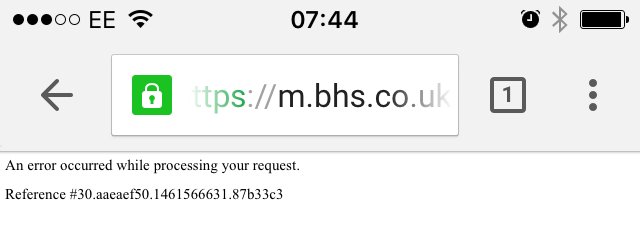
Intereseting today when I was looking at the checkout process I got the following page
bhs-checkout

This was prior to administration being formally confirmed so perhaps they had taken the site offline or as sometimes happens the site was overloaded due to sudden interest due to press attention. It would be interesting to see their visitor stats for the last couple of days and compare them with previous periods.

Interestingly they have not updated their twitter page since the weekend, and what will happen to the new Eastbourne food store that was annunce on twitter to have opened on 21st April.

Should you still buy whether pnline or instore is the question? Even though the site states they are trading as normal there has to be some question mark over goods being delivered at a later date and there would also be no guarantee you could return items. Filing for administration unfortunately must mean sales could be further impacted due to confidence in the offering.


contactless and no pin required

one of the newest methods of payments on the high street; todays debit and credit cards allow you to pay upto £30 just by waving your card in front of a card reader, no pin needed.

so what can go wrong? on tonights itv show how safe is your money an it security expert showed how just by bumping into someone with a mobile device with a vard reader app they had put together they were able to get enough information from the contactless card in the victims pocket to then go and use the card details online to make purchases above £30. you might say but hang on what about verified by visa , card security code (not sure is they got the code from the swipe i must say they implied not) well amazon don’t actually ask for the security code and do not use verified by visa or 3d secure at the checkout. a number of companies don’t as its perceived in the ecommerce world as a potential reason for abandoned baskets which is bad for the retailer. it seems that a fair number of customers can never recall the numbers they set up so will abandon their shopping basket ay checkout. retailers that use the verification process are actually protected by the card issuing companies if a fraudulent transaction is found to have taken place, they are not covered if this process is not undertaken.

i have heard a director of an online retailer actually say the fraud levels they were operating at were below industry averages and security and checking was too tight!

fraud involving contactless cards is a new type of fraid and last year it totalled  around £2.8 million where as fraud involving telephone and online transactions totalled £170 million.

there are now wallets and purses out there that are encased in metal to stop reading of contactless cards by people using available card readers. imagine being on a packed tube, or walking down oxford street and a person in your carriage or walking down the road with one of these devices. you would have no idea until you next look at your account online.

privacy, social and search and so it continues

Publicity surrounding the celebrity injunction in relation to the publication of details of an alleged threesome shows no signs of subsiding. The UK press namely the Sun are in court later this week to try and overturn the injunction, the Daily Mail on a daily basis continues to publish stories of where the details have now emerged. We have learnt that the injunction is only applicable in England and Wales, so a Scottish Newspaper has published the names and picture of the supposed celebrity couple. It seems that the injunction stops any England and Wales based websites and publications even naming the Newspaper. We have now discovered a prominent UK based political blogger has published the details on their blog, it would appear they can do this as the sites hosting is based in the USA. It would also appear that a major USA television network has named the couple. A UK MP was supposedly going to use parlimentary privildege to ask a question in parliment naming the couple in the process in a similar manner to how Ryan Giggs was named a few years back. The speaker of the house has stopped the MP from doing this.

Today we learn of a Conservative MP who has been named who had the misfortune of dating for a brief period of time a couple of years back a lady from the website match.com who turned out to be a dominatrix. Once he found this out (she did not tell him) supposedly by the press tipping him off of an impending story he stopped dating her. The story was never published and has only just come to light. Conspiracy theory has gone into overdrive as the said MP is involved in handling the current press regulations in the wake of the phone hacking scandal. Certain organisations and opposition MPs believe he has been compromosed with the theory that the story was not published so it can be used with other stories to leverage changes to the regulations that restrict the press activity.

Both the names pf the celebrity couple and the third party involved are widely available on search sites and social media sites. It is also very easy to find details of the dominatrix though no injunction exists for keeping the name hidden.

Google trends makes interesting reading. So what is google trends; Its a website owned by google that displays the current search term trends i.e. what we are searching for. Just drilling into the site shows graphs of by hour, by day, by month, by years of search topic trends. As a user you can enter a search term and see how frequently the term has been searched over a specified period of time. Just using the celebrity name shows  large spike in the last week, with few searchs over the previous year; interestingly the site also shows related search terms and the names of over involve parties as readily identified.


the tax year change and other stories

so in the early hours of the 6th april I wonder how many other people were busily runnig update scripts on their company databases  to ensure the next tax year figures came into effect and no doubt how much searching of emails and file shares occurred to try and work out what you did the year previously or the person that carried out the task has left and the first you know about it is either a calendar entry pops up to remind you or sometimes its too late and the data coming out the system if found to be in error.

why does this situation occur? too often project budgets do not allow for maintenance screens and routines to be built or the project has overrun and cost cutting forces these tasks to be removed and be deemed a bau support process. quite often design decisions fail to recognise that certain key information may change on a set date , even worse are the cases where by  values are hardcoded into an application meaning the application has to be modified and redeployed.

examples i have seen of hard coding have been VAT rates who would think the UK rate would change from 17.5% to 20%, obviously the millenium example of upper date checking against 31/12/1999 and where a structured numeric identifier is used to identify a category or type i.e. 200000 to 299999 is crime novels; 300000 to 399999 is graphic novels unfortuantely what happens when the numbers are exhausted.

you would hope that this would not occur in todays system solutions but i have seen that this not to be the case. cutting corners and lack of forward planning are still very evident in enterprise solutions

privacy, social and search

Once again a high profile celebrity has been granted a court injunction to stop the reporting in the uk of details of a threesome his partner was supposedly involved in. the injunction only applies to the UK. A US news publication has named the celebrity and his partner and given details of the infidelity.

Almost immediately and namely the social media networks were awash with the names; google and bing searches were just as fruitful. As with other high profile celebrity injunctions and more serious criminal cases such as the recent adam johnson case anomonimity if granted cannot be guarenteed. Naming such prople in the UK granted anonomous status in the UK can result in prosecution of the person that releases the details though how many people have been prosecuted I am unsure.

Obviously one could argue that injunctions surrounding celebrity relationship scandals just show that some people have too much money; quite often the same celebrity is quite happy to sell stories of their life to magazines for vast sums of money but are not so keen on scandal appearing in the pubic domain even if their partner knows the details.

Where as victims of crimes committed against them who have been granted anonimity should be allowed to remain anonomous,

So how do Social Media and Search Engines fail to protect the victims.

If you take google and bing as search engines the search pages as part of the search result have content sections that show related searches that have been carried out by other users. The search boxes themselves show drop downs of related searches. Quite rapidly the names of people granted anomonimity appear in these sections. From these names it can be quite easy to find more personal information of these people.

Even twitter and facebook have similar search functionality where related results and searches are shown. Quite quickly innocent names can on twitter appear in the trending section.

Obviously quite quickly the results are adjusted and names are removed by moderators but one would presume this would only occur after a complaint has been made. The alogorithms dont seem to stop everything and perhaps only the link to the content that has been complained about. It is quite easily to spoof your location and search in countries where the data has not been removed to find the details that have been surpressed in say the UK.

More should be done to stop victims names from becoming known in the public domain; the internet has no borders and court orders in one country do not apply in other countries.